
| Check | What it tells you | Planning use |
|---|---|---|
| Posted grade or rating | In New York City, violations carry point values that map to a letter grade, and a lower score is a better grade. On the UK scale the best standards earn a maximum rating of five. | Use it as a quick screen. Confirm it against the full record before you book. |
| Public inspection database | New York’s ABCEats tool covers about 29,000 restaurants. UK scores are published online by the Food Standards Agency. | Search by name and read the detail, not just the headline score. |
| Restroom condition | Expert advice treats the state of the toilets as a signal of kitchen standards. | Look before you order, while you can still leave. |
Figures above come from the New York City Health Department’s restaurant grades page and a BBC report on UK hygiene ratings.
How to tell if a restaurant is clean comes down to two checks: the official inspection record and what you can see for yourself, such as a posted grade, the restroom and how food is served.
Cleanliness is only one part of choosing where to eat, so read it alongside a restaurant review that covers food and service. The sections below follow the order in which you can act: before you go, at the door, in the restroom, and when the record looks poor.
Before you go: read the official record
The most reliable evidence is gathered by inspectors rather than by diners. Environmental health agencies routinely inspect restaurants to assess compliance with food safety regulations, according to a peer-reviewed survey of local agencies. Checking their findings takes a few minutes and is the best first step.
What a grade or rating means
A grade condenses an inspection into one symbol. In New York City, violations of food safety rules carry point values and a restaurant’s score corresponds to a letter grade. The lower the score, the better the grade, as the city’s Health Department explains. That direction is easy to misread, because the UK scale runs the other way: the best standards are rewarded with a maximum rating of five, per the BBC’s account of the scheme.
A rating describes one inspection, not a permanent state. In February 2016 the same report counted 14,251 UK food outlets scoring two or below, nearly 9% of premises inspected. Of those, 973 scored zero, the group needing urgent improvement. Most inspected premises scored above that line, so a very low rating is an outlier worth taking seriously.
Where to find inspection records
Records are public, but where they sit depends on the jurisdiction. New York City publishes results for 29,000 restaurants on its ABCEats tool. UK scores are published online by the Food Standards Agency. Elsewhere, the local health department is the place to start. Healthy Talbot notes that inspection scores can be checked through the health department, and you can ask the department for a copy of the report.

- Identify the health department that covers the restaurant’s address.
- Search for the restaurant by name in its public database, such as ABCEats in New York City.
- Open the full report and read the listed violations, not only the score or letter.
- If nothing is posted online, ask the department for a copy of the report.
The table below compares how the systems named in this guide present their results.
| Jurisdiction | Scale | Display and lookup | Planning use |
|---|---|---|---|
| New York City | Letter grade from violation points; lower score is better | Results searchable on ABCEats | Check the record even when the card looks fine. |
| England, Scotland and Northern Ireland | Rating with a maximum of five | Display not required; scores published online | Look the premises up online rather than relying on a window sticker. |
| Wales | Same rating approach, sticker shown | Display required by law in a prominent place | A missing sticker is itself worth noticing. |
Details come from the New York City Health Department and the BBC’s UK ratings report.
At the door: what you can see
A posted grade card is the most visible signal, but how much it tells you depends on local law. In Wales, all businesses must by law display the sticker, so its absence there deserves a closer look. In England, Scotland and Northern Ireland restaurants are not obliged to display their rating, so a missing sticker proves nothing and an online search settles the question.
Beyond the card, use your own eyes as a supplement to the record, not a replacement for it:
- Dining room: tables that are cleared and wiped promptly and floors free of debris suggest staff attention to routine cleaning.
- Service: staff who keep their hands and aprons tidy while handling plates show habits that carry through to the kitchen.
- Overall impression: if anything feels off before you sit down, leaving costs nothing, while eating there may.
These cues are quick judgements, and an inspection captures what a diner cannot see. A spotless room with a poor record is a mixed signal, so go back to the report when the two disagree.
In the restroom: a quick proxy for the kitchen
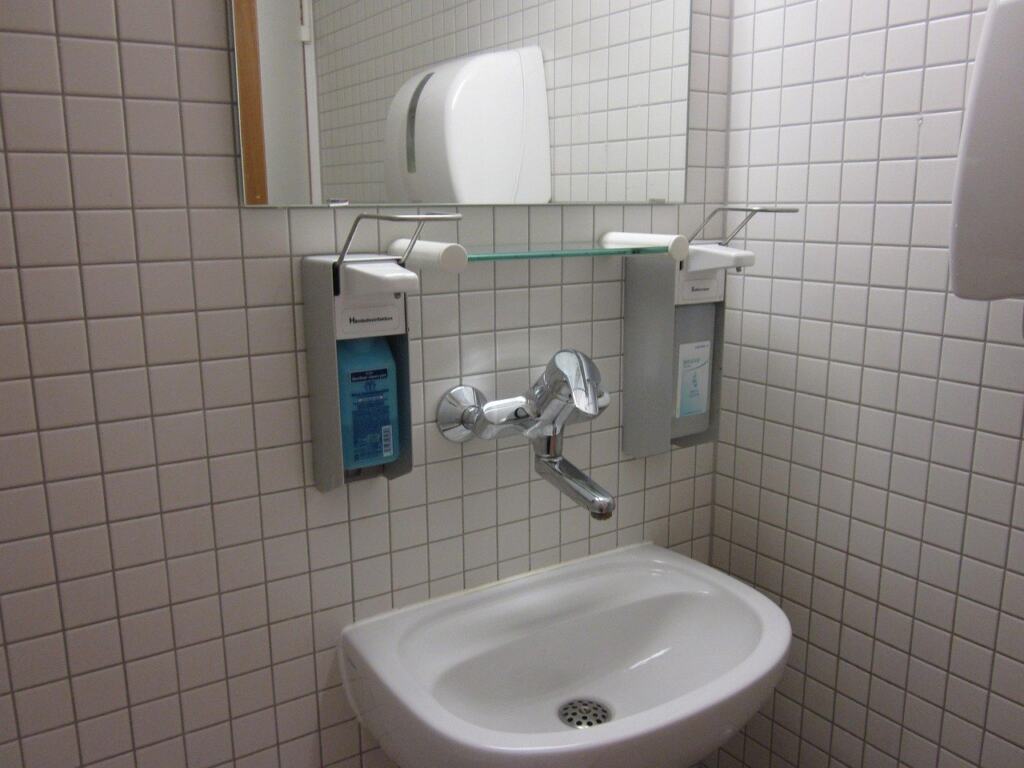
The restroom is the one back-of-house area most diners can inspect. Advice quoted by the BBC is blunt: go in the toilets and see what it looks like in there. The logic is that the standard of upkeep in the toilets tends to reflect standards behind the scenes. Treat that as expert advice rather than proof.
Look for working soap and a way to dry hands. Food safety guidance from the restaurant industry says employees should wash their hands after using the restroom, which makes a stocked sink more than a courtesy, according to the National Restaurant Association’s inspector checklist.
Water for drinks is another place to look. A BBC test of ice at one fast-food branch found high levels of what scientists call faecal coliforms. That is a single example, not a pattern for all restaurants, but it shows that contamination can sit in items nobody thinks to inspect.
The kitchen violations that matter most
Not every violation carries equal risk for a diner. Cosmetic issues rarely cause illness, while failures that let bacteria grow or spread do. Cross-contamination is named as one of the leading causes of foodborne illness by the restaurant industry’s guidance for inspections, so it deserves most of your attention when you scan a report.
- Temperature control: hot food should be held at or above 135°F and cold food at or below 41°F. Foods that sit between 41°F and 135°F can become unsafe. Healthy Talbot’s guidance gives a danger zone of 40°F to 140°F, so published boundaries differ slightly, but the message is the same: keep hot food hot and cold food cold.
- Handwashing: employees should wash after using the restroom, among other listed tasks. A report citing handwashing failures points to a practice that reaches every dish.
- Sanitizing: sanitizing reduces bacteria on a surface to safe levels, and sanitizers should stay in contact with food-contact surfaces for 10 to 30 seconds. Violations here suggest surfaces are not being treated properly between tasks.
- Record keeping: inspectors expect a written or electronic record of when temperatures were taken and by whom. Missing logs are less alarming than a recorded temperature failure, but they leave the checks unproven.
When you read a report, sort the violations. Items about temperature, handwashing or cross-contamination suggest an active risk. Isolated paperwork or maintenance items are a weaker reason to avoid a place, especially if the rest of the record is clean.
When the rating is low
A low rating does not guarantee illness, and a high one does not guarantee safety. It signals that inspectors recorded problems, and your job is to judge which. A survey study of 140 agencies in 2020 found that agencies that graded restaurants and routinely disclosed results to the public reported fewer foodborne illness outbreaks. That is an association at agency level, not a promise about any single restaurant, but it shows why checking public grades is worthwhile. The same paper notes that in 2017, 489 of 841 outbreaks (58%) were attributed to food prepared in restaurant settings.
Use this decision rule:
- Choose elsewhere if the report lists temperature, handwashing or cross-contamination violations, or if the rating sits at the bottom of its scale.
- Go cautiously if the problems are minor and the restroom and dining room look sound. Order dishes that arrive properly hot.
- Look further if the record is thin or old. Customer comments can add context, and a guide on how to read restaurant reviews explains how to weigh them.
Guide listings answer a different question from an inspection record, and a separate explainer covers what do michelin stars mean. Whatever the recognition, run the same record check.
If you get sick
Diners are part of the safety net. Most outbreaks in restaurants are detected through surveillance of complaints from consumers, according to the same survey study. Report suspected foodborne illness to the local health department, and do so especially when more than one person got sick after the same meal, as Healthy Talbot advises.
Frequently asked questions
How often are restaurants inspected?
It depends on the jurisdiction. New York City’s Health Department conducts unannounced inspections of restaurants at least once a year.
Which certificates should I look for?
Look for certificates showing that kitchen managers have completed food safety training, as suggested by Healthy Talbot.
How quickly should restaurant leftovers go in the fridge?
Get them into the fridge within two hours, or within one hour on a hot day, according to Healthy Talbot’s dining-out guidance.